Discounts are easy to give and hard to take back. A discount that looks small on a price tag can cut your profit by far more than it appears, because it comes straight off your margin and not off your costs. This guide shows how to test a discount before you offer it and how to choose ones that earn their cost.
- A 20% discount on a product with a 40% margin needs twice as many sales just to earn the same gross profit.
- Work out the extra volume you need before you announce any discount.
- Bundles, free delivery thresholds and early-payment terms often beat a straight price cut.
- Time-limit every promotion and show the original price and the discount clearly.
See the real effect on profit
Suppose a product sells for 50 and costs 30. The profit is 20 per unit, a margin of 40%. A 10% discount takes the price to 45. Costs have not changed, so the profit falls to 15, and the margin to 33.3%. A 10% cut in price has cut your profit per unit by 25%. A 20% discount takes the price to 40, leaves a profit of 10, and halves your profit per unit.
How much extra volume do you need?
A simple formula tells you how many more units you must sell just to stand still. Extra volume needed = discount ÷ (margin − discount), with both as percentages of the original price. With a 40% margin, a 10% discount needs 10 ÷ 30, or 33% more units. A 20% discount needs 20 ÷ 20, or 100% more units, double your sales. If a promotion cannot realistically deliver that, it will reduce your profit, however busy it feels.
Types of discount
Volume discounts reward larger orders. Early payment discounts reward paying quickly. Seasonal and clearance discounts shift stock. Loyalty discounts and coupons bring back customers or attract new ones. Bundles sell more by combining items. Each has a different purpose, and judging them by that purpose is better than asking whether the price is lower.
Testing a volume discount
Take a product that costs 11. Selling 1 to 9 units at 20 gives a margin of 45%. From 10 to 49 units at 18 gives 38.9%. From 50 units at 16 gives 31.25%. Each tier still earns a profit, but the larger the order, the more you must rely on the extra work being saved. Check each tier against the costs you really save, such as packing and handling, and be sure the volume tiers are not set so low that most customers qualify for the discounted price.
Early payment discounts
A discount such as 2% for payment within 10 days on a 30-day invoice works out to a high annual cost, around 37%. It may be worth it if you need cash and the alternative is expensive. Otherwise it simply gives away margin. We explain this in how to get paid faster.
Clearance and seasonal sales
Discounting slow stock can be sensible if the alternative is holding it for months. The relevant comparison is the discounted price against what the stock will be worth if it stays unsold, not against the original price. Releasing cash also has value. See inventory turnover for how to find the stock that needs this.
Protect your brand and customers
Frequent discounts can train customers to wait for the next sale and weaken the perceived value of your product. If you do discount, give the sale a clear reason and an end date, and consider discounts that do not change the shelf price, such as bundles or gifts with purchase.
Control discount codes
Codes spread. A code meant for newsletter subscribers can end up on a coupon site. Set limits, such as one use per customer, an expiry date, or a minimum order, and review how much of your revenue is being discounted. If more than a small share of orders use a code, it is no longer a promotion but a price cut.
Show discounts clearly on invoices
On an invoice, show the discount as its own line, with the percentage and the amount, so the customer sees what they saved and your records show it clearly. Our invoice generator has a discount field that does this and recalculates the tax and total.
Work it out before you promote
Use our discount calculator to see the sale price and saving, and check your margin at that price with the markup calculator. For the pricing side, see markup vs margin. This guide is general information, not financial advice.
How much more you need to sell
The extra sales needed to keep the same gross profit after a discount is discount ÷ (margin − discount). The table shows how quickly it grows. If the discount is equal to or larger than your margin, no amount of extra sales will help, because each sale loses money.
| Your gross margin | 5% discount | 10% discount | 20% discount |
|---|---|---|---|
| 30% | +20% sales | +50% sales | +200% sales |
| 40% | +14% sales | +33% sales | +100% sales |
| 50% | +11% sales | +25% sales | +67% sales |
| 60% | +9% sales | +20% sales | +50% sales |
For example, a shop with a 40% margin that runs a 10% sale must sell about a third more units just to stand still.
Better alternatives to a straight price cut
- Bundles: sell two related items together for slightly less than buying them apart. You move more stock and keep a higher average order value.
- Free delivery over a threshold: set it just above your current average order, so customers add one more item.
- Gift with purchase: a low-cost extra feels generous but costs far less than a percentage off.
- Loyalty rewards: reward repeat customers instead of discounting for everyone.
- Volume tiers: lower prices only for larger quantities, so the discount pays for itself.
When a discount does make sense
Discounts are useful for clearing slow-moving or seasonal stock (where holding it costs money), for winning back a lapsed customer, or for rewarding faster payment when you need cash. In each case, decide the goal, the limit and the end date first.
How to do it with GoInvoicePrint
You can do this in a couple of minutes with our free Discount Calculator. No download is needed and it works on your phone too.
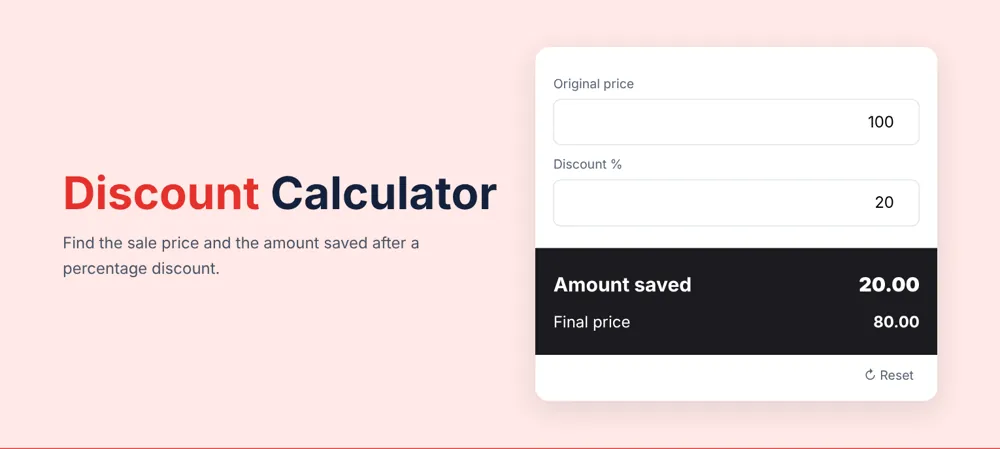
- Open the free Discount Calculator and enter the original price and the discount percentage.
- Read the amount saved and the final price.
- Check the new margin with the Markup Calculator, using your cost and the discounted price.
- If you go ahead, show the discount on the invoice using Disc % on a line, or Discount % in Totals, so the customer sees the original price too.
Frequently asked questions
What is a reasonable discount for a small business to offer?
Many small businesses keep routine discounts between 5% and 15%. Larger discounts are usually kept for clearing stock or short promotions. The right figure depends on your margin – use the table above.
Is it better to discount or to add value?
Adding value – a bundle, a free extra or faster delivery – usually costs less than a price cut and does not train customers to wait for sales.
How do I show a discount on an invoice?
List the item at its normal price and show the discount as a percentage or a separate line, then the reduced total. This makes the saving visible and keeps your normal price clear.
Do discounts reduce sales tax?
In many places tax is charged on the price after a discount given at the time of sale. Rules differ for coupons, early-payment discounts and loyalty schemes, so check with your tax authority.